

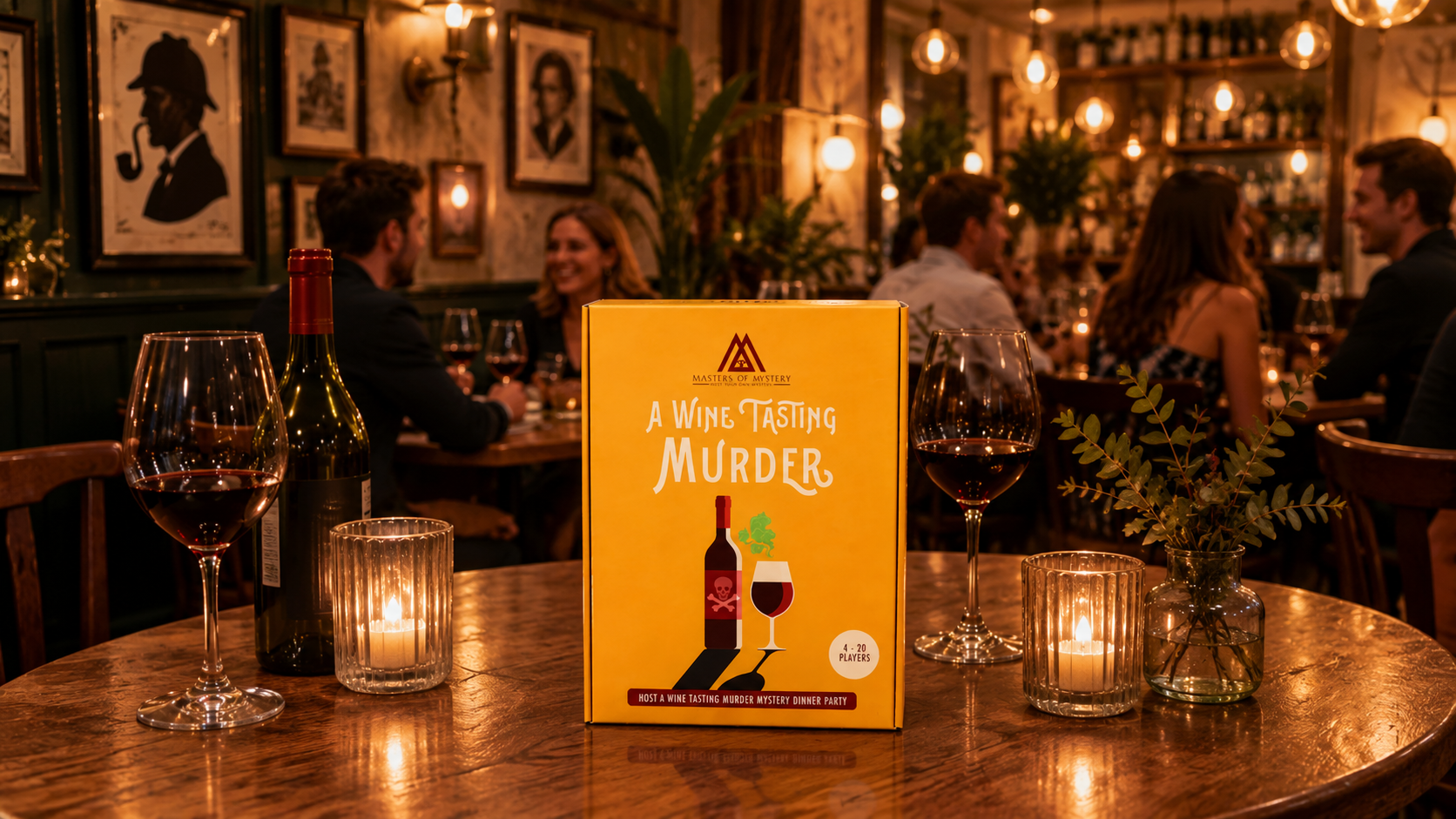
A good restaurant murder mystery night does more than fill tables on a quiet evening. It creates a reason for guests to book, dress up, stay longer, order another drink and come back for the next theme. However, a ticketed event needs more structure than a casual dinner party at home.
At Masters of Mystery, we see restaurants, bars, cafes, hotels and event venues use mystery nights because they turn hospitality into an experience. Food matters, of course. But when guests also have suspects to question, clues to follow and a final reveal to wait for, the evening becomes far more memorable.
If you are planning restaurant murder mystery nights, this guide covers the practical pieces: licensing, player numbers, food service, table teams, timing, digital materials and how to keep repeat events fresh.
Start with the commercial licence
If you are planning a ticketed event where guests are paying to attend, promoting the event publicly, or running the murder mystery as part of your restaurant, bar, hotel or venue's commercial offering, you will need a commercial licence. This ensures the game can be used as part of a paid event and complies with our commercial licensing terms.
A private dinner party at home does not require a commercial licence. However, once guests are paying to attend or the event is being run for commercial purposes, a licence is required.
Masters of Mystery's commercial licence covers businesses using our games in promotional material or advertising, as part of a business or service offering such as venue entertainment, corporate events or team-building activities, for publicly promoted paid events, or for any commercial use where the game forms part of a profit-making service.
This matters because a private dinner party and a ticketed restaurant event are very different. If your guests are purchasing tickets, the event is being advertised to the public, or you are running the game to generate revenue for your venue, you should ensure the correct commercial licence is in place before promoting or hosting the event.
As a result, you can confidently plan your event knowing you're using the game in line with our licensing terms while creating a professional experience for your guests.
Choose the right format for your venue
Not every mystery format suits a restaurant. Some games work best when every guest has an individual role. Meanwhile, larger venues often work better with table teams, where each table acts as an investigation group.
For restaurants, the strongest formats usually have:
- clear host instructions
- character booklets or role information
- evidence reveals that can happen between courses
- flexible player counts
- digital materials for screens or host tablets
- strong theme potential for food and décor
Masters of Mystery kits commonly include character briefs, evidence and hosting guidance, and our full range of murder mystery games supports in-person or virtual play, with downloadable materials that can be shared digitally.
Match the theme to your menu
The easiest events to sell are the ones guests understand instantly. Therefore, choose a theme that fits your food, your room and your audience.
Wine Tasting mystery
For wine bars, restaurants and adult social evenings, a wine tasting mystery is a natural fit. Masters of Mystery’s Wine Tasting murder mystery game is set around a vineyard showcase, harvest gala or private tasting event, where the celebration turns suspicious after one guest is found dead.
This theme pairs well with tasting flights, cheese boards, small plates and premium drink packages. In addition, it lets the wine list become part of the atmosphere rather than a separate upsell.
Masquerade mystery
For venues with evening lighting, private dining rooms or party packages, a masquerade theme works brilliantly. The Masquerade Ball and Carnival game offers 4 to 20 player options, instant digital access or boxed kit formats, and can be played in real life or virtually.
Masks also make the event feel special without asking guests to buy full costumes. Consequently, it is an easy theme for first-time ticket buyers.
1920s mystery
For venues that want a bigger visual event, a 1920s theme brings glamour, jazz and strong dress-up appeal. Masters of Mystery’s 1920s game is available in boxed and instant digital formats, and the game includes host-friendly features such as detective recordings, replayable structure and 1.5 to 3 hours of gameplay.
This is especially useful for special menus, themed cocktails and premium ticket nights.
Structure the event around service
A restaurant mystery night should never fight the kitchen. Instead, build the clues around your service rhythm.
A simple structure might look like this:
- arrival drinks and character check-in
- host welcome and rules
- starter and first clue reveal
- table discussion
- main course and second clue reveal
- cross-table questioning or host-led suspect round
- dessert and final evidence
- accusations, voting and reveal
- prize moment and rebooking announcement
This rhythm helps staff serve smoothly while the game keeps moving. In practice, guests also appreciate knowing when to eat, when to talk and when to focus on the host.
Use table teams for bigger nights
For groups over 20, table teams can work better than trying to give every guest an individual character. Each table can act as a detective unit, while key roles or suspects sit across the room.
This format works particularly well for restaurants because guests already arrive in bookings. A table of four, six or eight can discuss clues together, compare theories and submit one accusation at the end.
Meanwhile, the host can reveal evidence to the whole room using printed sheets, a screen or table envelopes. This keeps everyone involved without making the event chaotic.
Use digital materials smartly
Digital files can be very useful for venue events. You can show key evidence on a screen, email character details to confirmed guests before the night, or keep the Host Guide on a tablet behind the bar.
However, do not show every clue at once. Mystery needs timing. Reveal information in stages so guests stay curious throughout the meal.
Masters of Mystery’s product information notes that downloadable kits can be used for on-screen play or home printing, with no physical items shipped for digital games. For venues, that same flexibility makes digital formats useful for controlled reveals, staff preparation and table copies.
Keep guests engaged between courses
The quiet danger in restaurant events is dead time. If guests finish a clue too quickly and wait 20 minutes for the next course, the energy drops.
To avoid that, give each table something small to do between reveals. For example:
- write one theory after each round
- vote for the most suspicious character
- choose one question to ask another table
- nominate a table detective
- submit a “best alibi” award
These activities keep the room talking without overwhelming service.
Train your host before the night
A ticketed event needs a confident host. This person does not need to be an actor, but they do need to control the room, pace the clues and explain the rules clearly.
The host should know:
- the running order
- where each clue appears
- how guests vote
- what staff need to serve and when
- what to do if a table arrives late
- how to handle a guest who dominates
- how to reveal the solution cleanly
In addition, brief the front-of-house team. Staff do not need to solve the mystery, but they should understand the event flow so they do not interrupt key reveals.
Make the event feel worth rebooking
A restaurant murder mystery night should end with momentum. Once the reveal happens, guests usually keep talking about who they suspected and what they missed. That is the perfect moment to invite them back.
Keep repeat nights fresh by rotating:
- themes
- menus
- table layouts
- prizes
- suspect roles
- arrival drinks
- costume prompts
Masters of Mystery notes that most murder mystery titles are replayable with different outcomes and murderers, and that rotating roles or using a different solution path can create a fresh experience.
For this reason, restaurants can build a repeat event calendar rather than treating murder mystery as a one-off novelty.
What should tickets include?
Keep your ticket offer clear. Guests should know exactly what they are buying.
A strong ticket package might include:
- entry to the murder mystery event
- welcome drink
- two or three course meal
- character or table team materials
- prizes for best detective or best costume
- final reveal and photo moment
If guests need to dress up, say so lightly. For example, “Costume encouraged, but not required.” This keeps the event fun without making it feel like homework.
How to market a restaurant murder mystery night
The strongest event listings answer practical questions quickly. Include the theme, date, start time, ticket price, food package, age guidance, dress code and whether guests need to prepare.
Use copy that sells the experience, not just the game. For example:
“Join us for an evening of dinner, secrets and suspicious behaviour. Enjoy a themed meal while your table works together to solve the mystery before the final reveal.”
This makes the event feel accessible, even for guests who have never played before.
People also ask
Do restaurants need a licence to run a murder mystery game?
Yes, if the game is being used commercially, promoted publicly, included in a business offering or used as part of a paid event, you should check the commercial licence requirements before hosting.
How many guests can a restaurant murder mystery night handle?
It depends on the game and the format. Smaller events can give guests individual roles. Larger events often work better with table teams and central clue reveals.
Can a murder mystery work around dinner service?
Yes. In fact, it often works best that way. Reveal clues between courses, give tables discussion time and use dessert for final accusations and voting.
How do you keep guests coming back?
Rotate themes, menus and character formats. Use replayable games where possible, and promote the next event before guests leave.
Final thoughts
A strong restaurant murder mystery night is not just a game placed on top of dinner. It is a complete event, built around pacing, food service, atmosphere and guest interaction.
At Masters of Mystery, we know the best mystery nights make people feel like they are part of the story. For restaurants, that is exactly the opportunity. Give guests a table, a meal, a secret and a suspect list, and suddenly the night becomes something they will want to book again.
Share:
Kids Murder Mystery Games for the Summer Holidays: Screen-Free Clue-Solving Fun
The Last Toast at the Vineyard: A Short Murder Mystery Story to Get You in the Mood