

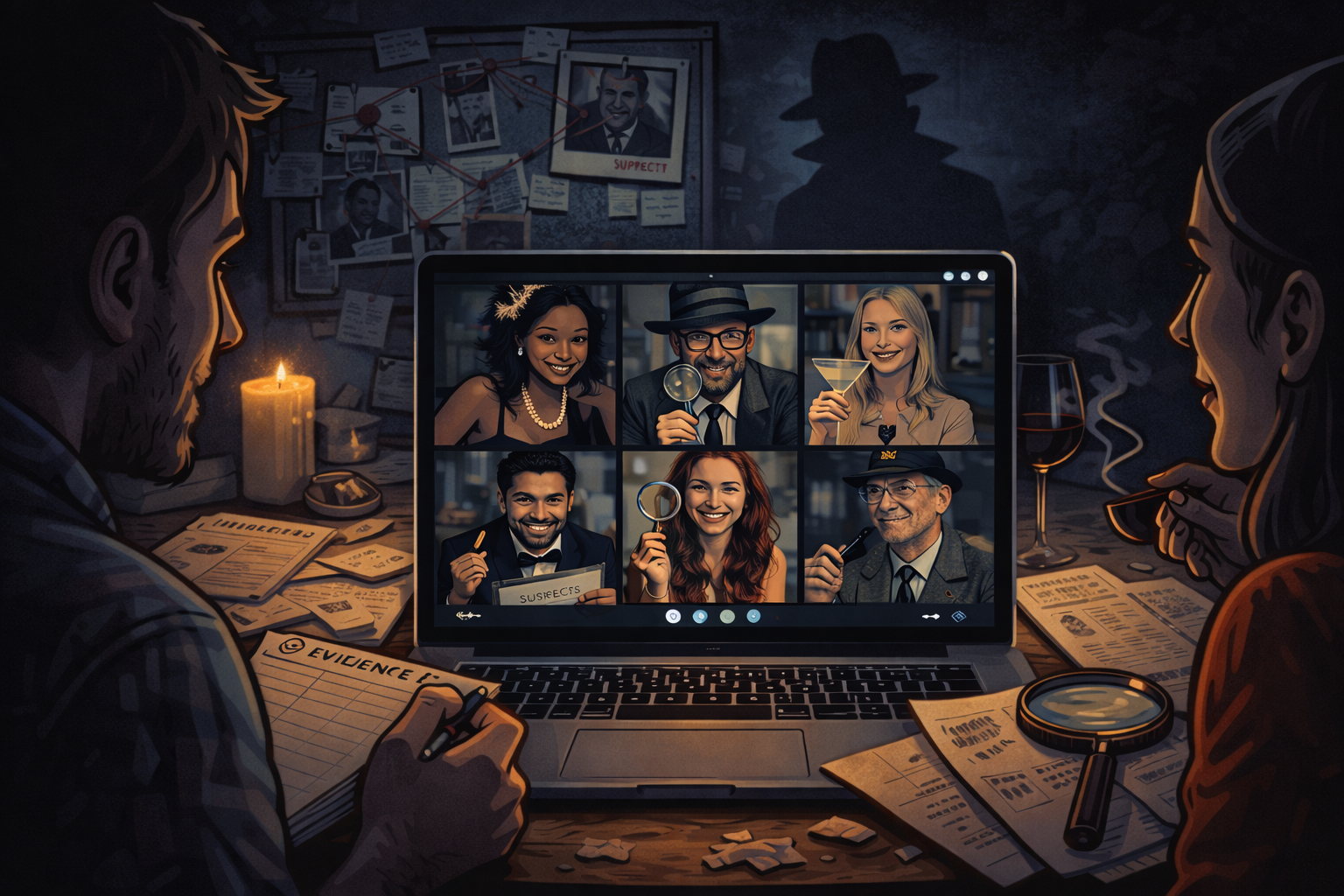
Remote teams do not need another generic quiz or a low-value social call. They need an event with structure, momentum and a reason to speak to one another. Few remote team-building ideas deliver that as reliably as a virtual murder mystery party, because every guest gets a role, a deadline and a shared problem to solve. If you are choosing a story for one, our full range of murder mystery games is the place to start.
That matters more than ever for distributed teams. Gallup's 2025 workplace data found fully remote employees were the most engaged group globally at 31 percent, yet they were also more likely to report stress, loneliness and lower overall thriving. In the UK, CIPD says employers most often see hybrid working negatively affecting managers' ability to lead teams effectively, employee connection to organisational purpose and organisational culture. In other words, remote work does not remove the need for social connection, it raises the bar for how intentionally you create it.
The strongest virtual formats also remove host friction. Masters of Mystery, for example, builds its virtual-ready experience around character briefs, evidence, hosting guidance and digital hosting instructions, with materials designed to work over Zoom or Teams and shared digitally before the event. That is the right standard for 2026, less improvisation, more structure. If you want a theme that suits almost any team, our 1920s Murder Mystery Game Kit is the one most groups choose first.
The 2026 checklist at a glance
Before you schedule your virtual murder mystery party, lock in these decisions:
-
choose Zoom or Teams and test every setting
-
decide whether the host is facilitating only or playing too
-
match the game to the group size and energy level
-
assign characters before the event, not on the call
-
send a clear pre-event briefing 48 to 72 hours early
-
plan a 90 to 120 minute running order
-
build in breakout room discussion time
-
use polls, chat and reactions with purpose
-
check captions, lobby or waiting room and backup host controls
-
finish with a reveal, debrief and a short social close
Is Zoom or Teams better for a virtual murder mystery party?
The best platform is the one your group already knows. Familiarity cuts friction, and friction kills momentum online. However, each platform has strengths that matter once the game starts.
When Zoom is the better fit
Zoom is usually the easiest choice when you want fast breakout-room control. It supports up to 100 breakout rooms, allows pre-assignment before the meeting, and can create breakout rooms from poll results. Hosts can also appoint co-hosts during the meeting, which helps when one person runs the story and another manages late arrivals, chat and room movement.
For a virtual murder mystery party, that matters because private side conversations create the game. If players can move cleanly into small-group discussions, compare alibis and return to the main room without confusion, the story keeps moving. In practice, Zoom works especially well for groups that want a slick, host-led experience.
When Teams is the better fit
Teams is strong when your remote team already lives inside Microsoft 365. Organisers can manage breakout rooms before or during the meeting, set time limits, appoint breakout room managers, run polls through Microsoft Forms, and control meeting access through the lobby and presenter settings. Teams also lets organisers adjust attendee chat, reactions and other meeting options, although some defaults are controlled by your IT admin.
That makes Teams a solid choice for corporate groups. If your company already uses Teams daily, you remove one major barrier, which is platform anxiety. Players spend less time learning controls and more time interrogating suspects.
How long should a virtual murder mystery party last?
For most remote teams, 90 to 120 minutes is the sweet spot. That is long enough to create immersion, but short enough to avoid video fatigue. If you stretch beyond two hours, energy usually drops unless the group is highly social and the facilitation is exceptionally tight.
A simple structure works best:
-
10 minutes for arrival, audio checks and renaming attendees
-
10 minutes for the host briefing and scene setting
-
25 minutes for round one clues and initial accusations
-
15 minutes in breakout rooms for private theories
-
20 minutes for fresh evidence, interrogations and twists
-
10 minutes for final accusations and voting
-
10 minutes for the reveal and short debrief
If you are hosting colleagues rather than close friends, keep the opening especially crisp. Remote teams usually engage better when the rules are clear before the roleplay starts. Therefore, explain the rules, the stakes and how accusations work before anyone starts acting in character.
How do you assign roles and brief players properly?
Bad role assignment ruins otherwise excellent mystery games. The host should never throw random names into the chat five minutes before the start. Instead, assign characters at least two days ahead and make sure each player understands the tone, objective and level of participation expected.
Start by matching confident communicators with central roles. Then give lower-pressure players characters that still matter, but do not carry the plot. Similarly, avoid giving two very quiet participants the two most clue-heavy parts. A good host balances personality, not just headcount.
This is where a polished format matters. Masters of Mystery's approach, for instance, relies on digital character briefs, evidence and host guidance, which is exactly what remote teams need because nobody can lean over a dinner table and ask what happens next. In some kits, the host can even play without knowing the ending in advance because the murderer is determined by the game mechanic rather than a fixed script.
Your pre-send pack should include:
-
character name and short backstory
-
costume guidance that feels optional, not compulsory
-
joining instructions for Zoom or Teams
-
start time and expected finish time
-
note on camera use and display names
-
one sentence on the tone, such as comic, dramatic or workplace-friendly
What should guests receive before the event?
Your briefing email or message should remove every avoidable question. Because remote players join from different devices, homes and time zones, ambiguity creates delays. A clean brief should tell people what to wear, when to join, whether to stay in character, and what to do if they lose connection mid-game.
Keep it simple. Ask guests to join 10 minutes early, rename themselves correctly, open their character pack before the call and keep a notebook nearby. If you want stronger participation, encourage light dress-up rather than a full-costume requirement. That usually feels more achievable, especially for workplace groups.
At the same time, do not overload people with lore. The goal is confidence, not homework. Give them just enough information to arrive ready to play.
How do you keep remote teams engaged throughout the night?
A virtual murder mystery party falls flat when the host treats it like an ordinary meeting with a mystery theme. Instead, run it like a produced experience. Keep instructions short, reveal clues in stages, and alternate between full-group moments and smaller conversations.
Use platform tools with a purpose
Breakout rooms should not exist just because they can. Use them for witness interviews, private alliances or team theories. Polls should not ask throwaway questions. Use them to force decisions, nominate prime suspects or lock in final votes. Meanwhile, chat works best as an evidence drop, a witness statement channel or a place for side clues, not a second event running in parallel. Zoom supports in-meeting chat and reactions, while Teams supports live reactions and meeting chat controls, so you can guide interaction rather than leave it to chance.
Put one person in charge of flow
The best online hosts separate performance from production. One person leads the room, handles tone and reveals clues. Another person monitors late arrivals, technical issues, polls and breakout timing. Zoom lets hosts assign co-hosts during a meeting, and Teams lets organisers add co-organisers and breakout room managers, which makes this two-person model practical.
Keep every player moving
Remote guests disengage when they wait too long for their turn. Therefore, make sure every round asks them to do something specific. Ask for a defence, a theory, a private accusation or a piece of hidden information. If a player stays silent for 20 minutes, the format is wrong, not the player.
What security and accessibility settings matter most?
Do not leave this to chance. Zoom's Waiting Room lets hosts control admissions, send messages to waiting participants and decide who bypasses the room. Teams offers similar control through the lobby, including settings for who bypasses it and who can admit attendees. For workplace events, that matters because an interrupted reveal kills momentum and can create privacy issues if external guests join unexpectedly.
Accessibility matters just as much. Zoom offers captioning options, and Teams can generate live captions in real time during meetings. Even when nobody has requested captions in advance, turning them on is smart hosting. Captions help with accents, audio quality, home noise and participant confidence, especially in a game built around clues and misdirection.
Finally, check your settings early. Teams notes that default meeting options may be controlled by your IT admin, while Zoom features such as chat, breakout rooms, co-host controls and captions can be enabled or restricted at account, group or user level. Test the exact meeting setup you plan to use at least a week before the event.
Final checklist before you hit start
Before you open the room, confirm these points:
-
the host and backup moderator have admin controls
-
breakout rooms are enabled and named if needed
-
polls are loaded and tested
-
character packs were sent and acknowledged
-
captions are ready to turn on
-
the lobby or waiting room is active
-
the reveal file sits in a separate window
-
players know whether they may private message
-
the event has a clean finish time
-
you have a five-minute debrief prepared
When you get those details right, a virtual murder mystery party stops feeling like another work call and starts feeling like a real shared experience.
A strong remote event is never about gimmicks alone. It is about pace, clarity and participation. That is why structured brands such as Masters of Mystery fit this category so well. The host gets clear guidance, players get defined roles, and the night keeps moving


Share:
Mother's Day Gifts for True-Crime Fans (UK): Games, Gift Cards and a 'Case File' of Ideas
The 2026 Murder Mystery Theme Guide: From “Traitors” Energy to Classic Christie