

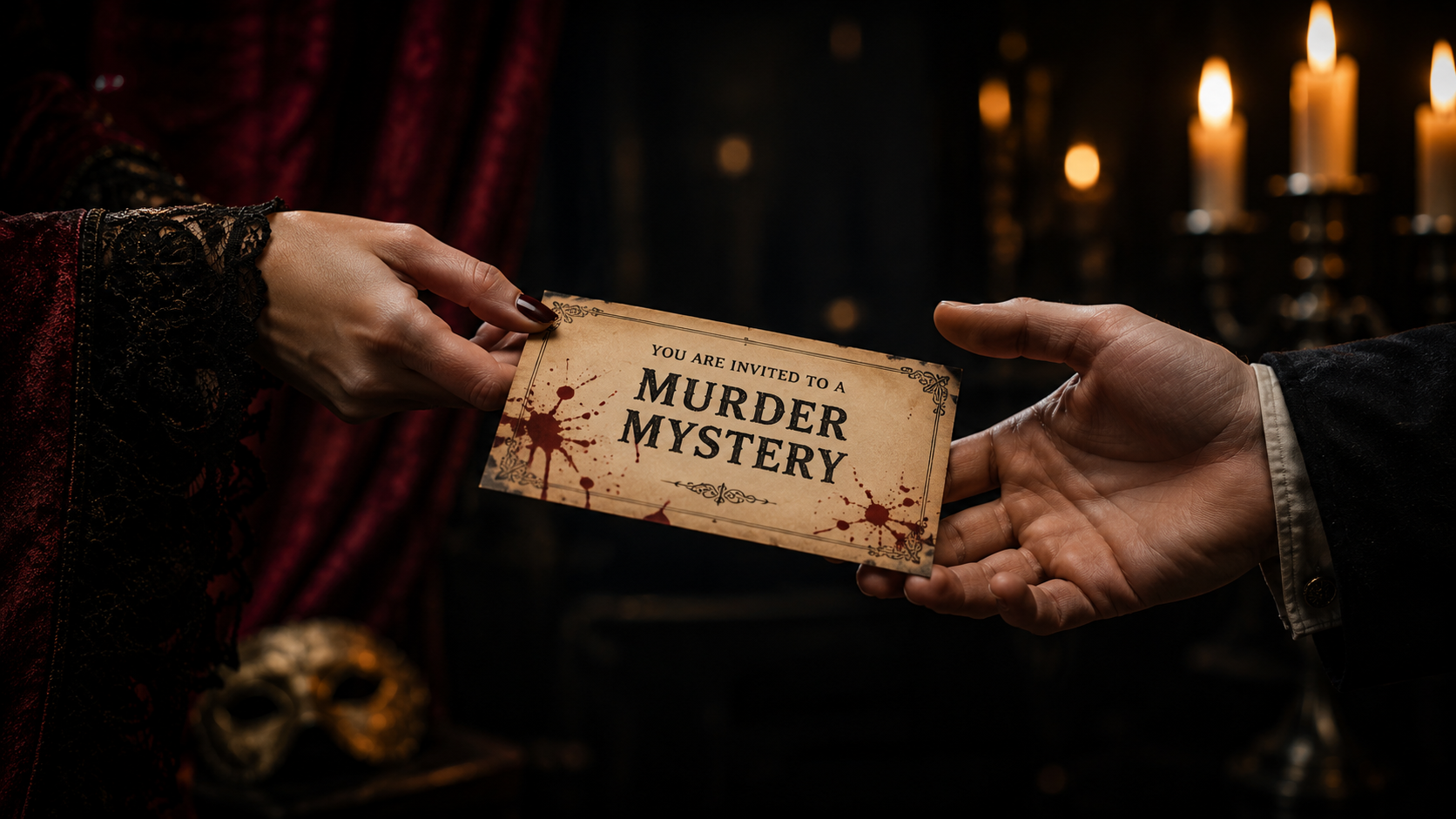
Learning how to play a murder mystery game should feel exciting, not intimidating. If you have never hosted before, it is completely normal to wonder what happens first, when clues are revealed, whether guests need to act, and how the final reveal actually works. The good news is that a strong murder mystery game gives you the structure before the first guest arrives.
At Masters of Mystery, we design our murder mystery party games so hosts can focus on creating the atmosphere, not inventing the whole night from scratch. Our kits include the core materials you need, including a Host Guide, character booklets, clue sheets, evidence files, invitations and costume suggestions. Many games also include audio or video scripts, depending on the format.
This guide walks you through the full process, from choosing a theme to revealing the killer, so your first mystery night feels smooth, confident and properly memorable.
The quick answer: how does a murder mystery game work?
A murder mystery game is a social party game where guests play characters connected to a fictional crime. Each player receives a role, learns their secrets, shares clues, questions other suspects and tries to work out who committed the murder.
Most games run in rounds. First, the host sets the scene. Then guests introduce their characters, reveal clues, discuss motives and ask questions. Finally, everyone votes on who they think the murderer is before the solution is revealed.
In practice, it feels like a dinner party, theatre game and detective story rolled into one. However, nobody needs to be a trained actor. The best nights happen when guests simply lean into the fun, ask questions and enjoy being suspicious.
Step 1: Choose the right murder mystery theme
The theme sets the tone for the whole evening. Therefore, choose a game that fits your group, not just the title that sounds most dramatic.
If your guests love classic detective stories, a Sherlock-style mystery or train mystery works beautifully. Midnight on the Orient Express is ideal for elegant dinner parties and classic whodunnit energy, while Murder at Moorbourne Manor gives you a rich Sherlock-inspired country house setting.
If your group prefers lighter, social themes, choose something instantly familiar. Our Bake Off themed murder mystery suits food lovers, birthdays and cosy group nights, while our Wine Tasting murder mystery is a strong fit for adult dinner parties, wine nights and social gatherings.
The easiest rule is this: if your guests understand the world quickly, they will play faster and relax sooner.
Step 2: Check your player count
Before assigning roles, confirm how many people are definitely coming. This matters because murder mystery games rely on characters, relationships and information. If you plan for eight people and twelve arrive, the game can become harder to manage.
Many Masters of Mystery games offer different player versions or expansion options. For example, some games support 4 to 8, 4 to 14 or 4 to 20 players, depending on the title and pack.
For a first-time host, 6 to 10 players is often a very comfortable size. It gives you enough suspects for a lively mystery, but not so many people that conversations become difficult to manage. However, larger groups can work brilliantly when you use clear rounds, strong hosting and the correct game version.
Step 3: Read the Host Guide before the party
The Host Guide is your map for the evening. It tells you what to prepare, when to reveal information and how to move players through the game. This is the one document we always recommend reading properly before game night.
Our help guidance explains the basic process clearly: choose a theme, download the kit, assign characters and follow the Host Guide from setup through to the dramatic reveal. Players read clues in rounds, question each other and vote on who they believe the murderer is.
You do not need to memorise the whole game. Instead, understand the flow. Know when the first clue appears, when guests should talk, when voting happens and where the solution is kept. As a result, you can host with confidence without feeling glued to the paperwork.
Step 4: Assign characters thoughtfully
Character assignment is one of the most important parts of learning how to play a murder mystery game. A good match helps guests feel comfortable from the start.
Give confident players the bigger personalities or central roles. They can help drive conversation and keep the energy high. Meanwhile, quieter guests can still have meaningful roles, but you may want to give them characters that focus more on clues, secrets or observation rather than constant performance.
This follows the same practical approach we recommend in our own hosting content. Major characters often suit more extroverted guests, while introverted guests can still take part fully with roles that fit their comfort level.
Once roles are assigned, avoid changing them unless you really need to. Guests often start thinking about costumes and character details as soon as they receive their booklet.
Step 5: Send invitations and character booklets
Your invitation sets the tone, so make it clear, themed and easy to respond to. Include the date, time, location, theme, dress code and RSVP deadline.
We usually recommend sending invitations two to three weeks in advance where possible. Once guests RSVP, you can send their character booklets with descriptions, costume suggestions and any final party details.
For last-minute hosts, digital kits make this much easier. Digital and printable Masters of Mystery games are available for instant download after purchase, and they are designed for home printing or on-screen use.
That means you can email character information, print essential clues and even display evidence on a laptop or TV if it suits your setup.
Step 6: Set the room before guests arrive
Atmosphere does not need to be expensive. In fact, the best first-time setups are usually simple and intentional.
Start with lighting. Use lamps, candles or fairy lights rather than bright overhead lights. Then set out character booklets, name cards, menus or clue envelopes if your game requires them. Keep the Host Guide nearby, but separate from anything guests should see.
Add small details that fit your theme. For Sherlock, use notebooks, old books and dark table settings. For Bake Off, use cake stands, aprons and pastel napkins. For Wine Tasting, use glasses, labels and a simple grazing board. For Orient Express, add elegant place cards and vintage travel touches.
The aim is not to build a film set. The aim is to help guests feel like the night has begun the moment they walk in.
Step 7: Start with a clear welcome
When everyone arrives, give them time to settle, get a drink and find their character materials. Then gather the group and explain the basic rules.
Keep this short. Tell guests:
- they should stay in character as much as they like
- they can ask questions and share information
- they should not reveal private information unless the game tells them to
- clues will arrive in rounds
- everyone will vote before the final reveal
Because some guests may feel nervous, reassure them that the goal is fun rather than perfect acting. A relaxed room always plays better than a room trying too hard.
Step 8: Run the clue rounds
Most murder mystery games use rounds to control the pace. This stops guests from receiving too much information at once and gives the mystery time to build.
A typical structure looks like this:
- opening scene and character introductions
- first clue round
- questioning and discussion
- second clue round
- more evidence and suspicion
- final clue round
- accusations and voting
- reveal
Masters of Mystery dinner party guidance also explains that games often progress in rounds, such as introductions during appetisers, a second clue phase during the main course and a final reveal over dessert.
As host, your job is to keep the room moving. If conversation slows, ask direct questions. If one guest dominates, invite someone quieter to share a theory.
Step 9: Encourage questioning and accusations
This is where the game comes alive. Guests should compare alibis, challenge contradictions and decide who seems suspicious.
Good questions include:
- Where were you when the murder happened?
- Who had a motive?
- Who benefits most from the victim’s death?
- Why did your story change?
- What are you not telling us?
However, keep the tone playful. A murder mystery night works best when suspicion feels theatrical, not personal. Encourage dramatic accusations, but keep the room friendly.
If your group includes first-time players, model the behaviour yourself. Ask a character a question, react to their answer and invite others to join in. Once people see how it works, they usually follow quickly.
Step 10: Vote before the reveal
The vote is important because it gives the investigation a proper finish. Before revealing the answer, ask every player to choose who they think the murderer is and why.
Some kits include game ballots, while others guide voting through the Host Guide. Masters of Mystery materials commonly include ballots or voting guidance alongside clues, character booklets and evidence materials.
For extra fun, add small awards at the end. You could give prizes for best costume, most suspicious behaviour, best detective work or most dramatic accusation. These little touches make the night feel complete.
Step 11: Reveal the murderer
The reveal is the big moment, so do not rush it. Gather everyone, make sure guests have voted and then follow the reveal instructions in your Host Guide.
Depending on the game, this may involve a final script, evidence explanation, detective recording or solution sheet. Some Masters of Mystery games use themed detective recordings and scripts, which can also allow the host to play along without knowing the murderer in advance.
After the reveal, give guests time to react. People love comparing theories, defending bad guesses and realising which clues they missed. In many ways, that post-reveal conversation is part of the reward.
Can the host play too?
Yes, in many Masters of Mystery games the host can play along. This is one of the reasons our kits work well for home parties. You can guide the evening without standing outside the fun.
Some titles use hidden solutions, detective scripts or randomised murderer mechanics so the host does not need to know everything in advance. For example, our physical Wine Tasting game notes that themed detective recordings and scripts allow the host to participate without knowing the murderer.
That said, first-time hosts may prefer to skim the full structure before playing. You do not have to spoil the reveal, but you should understand the order of events.
Common first-time host mistakes to avoid
The biggest mistake is overcomplicating the night. You do not need ten side activities, a perfect menu and a fully transformed room. The game already gives the evening its structure.
Avoid these common errors:
- sending character roles too late
- choosing a game that does not match your group size
- making costumes feel too demanding
- serving food that keeps you stuck in the kitchen
- revealing too many clues at once
- rushing the final vote
- forgetting to read the Host Guide beforehand
In contrast, the best hosts keep things clear. They give guests enough information to play, then trust the story to do its job.
Frequently asked questions
Is a murder mystery game hard to host?
No, not when you use a structured kit. The Host Guide explains what to do, when to reveal clues and how to finish the game. Your main job is to guide the room and keep the energy moving.
Do guests need to act?
Not properly. Guests can play as dramatically or casually as they like. Some people go fully in character, while others simply read clues and ask questions. Both approaches work.
How long does a murder mystery game take?
Most games take around 1.5 to 3 hours, depending on the number of players, food breaks and how much roleplay your group enjoys. Wine Tasting, for example, typically takes 1.5 to 3 hours.
What is the best murder mystery game for beginners?
Choose a theme your group understands instantly. Bake Off is great for relaxed social groups, Sherlock works well for clue lovers, Wine Tasting suits adult dinner parties, and Orient Express is ideal for classic whodunnit fans.
Final thoughts
Once you understand how to play a murder mystery game, the whole idea becomes far less daunting. Choose the right theme, assign characters thoughtfully, follow the Host Guide and reveal clues in clear rounds. That is the core of a great night.
At Masters of Mystery, we build our games to help first-time hosts feel prepared, not overwhelmed. The structure is there when you need it, but the fun still comes from your guests, their theories, their costumes and the moment everyone realises they suspected the wrong person all along.


Share:
Eurovision Party Games: How to Host a Singing Competition Murder Mystery Night
Printable vs Boxed Murder Mystery Kits: Which One Is Better for Your Party?